
Affiliate marketing remains one of the most cost-effective channels for publishers and content creators. The U.S. industry is projected to hit $14.47 billion by 2027, according to EMarketer. Affiliates executing with a clear plan consistently earn $6 to $12 back for every $1 spent.
But results at that level do not come from simply adding links to content. A strong affiliate marketing strategy is about placing the right links, inside the right content, for audiences already primed to act.
This guide breaks down the proven tactics driving affiliate clicks, conversions, and real revenue in 2026 — based on what is actually working today. Whether you are just starting out or looking to scale an existing content portfolio, these tactics apply across niches and traffic sources.
Affiliate marketing is not a passive income shortcut. The publishers earning consistently at scale treat it as a system — with defined content formats, tested link placements, optimized CTAs, and tracked performance at every stage.
Publishers combining owned content with professional affiliate marketing services consistently outperform those relying on a single monetization channel, because diversified affiliate income compounds as content scales over time.
Link Placement
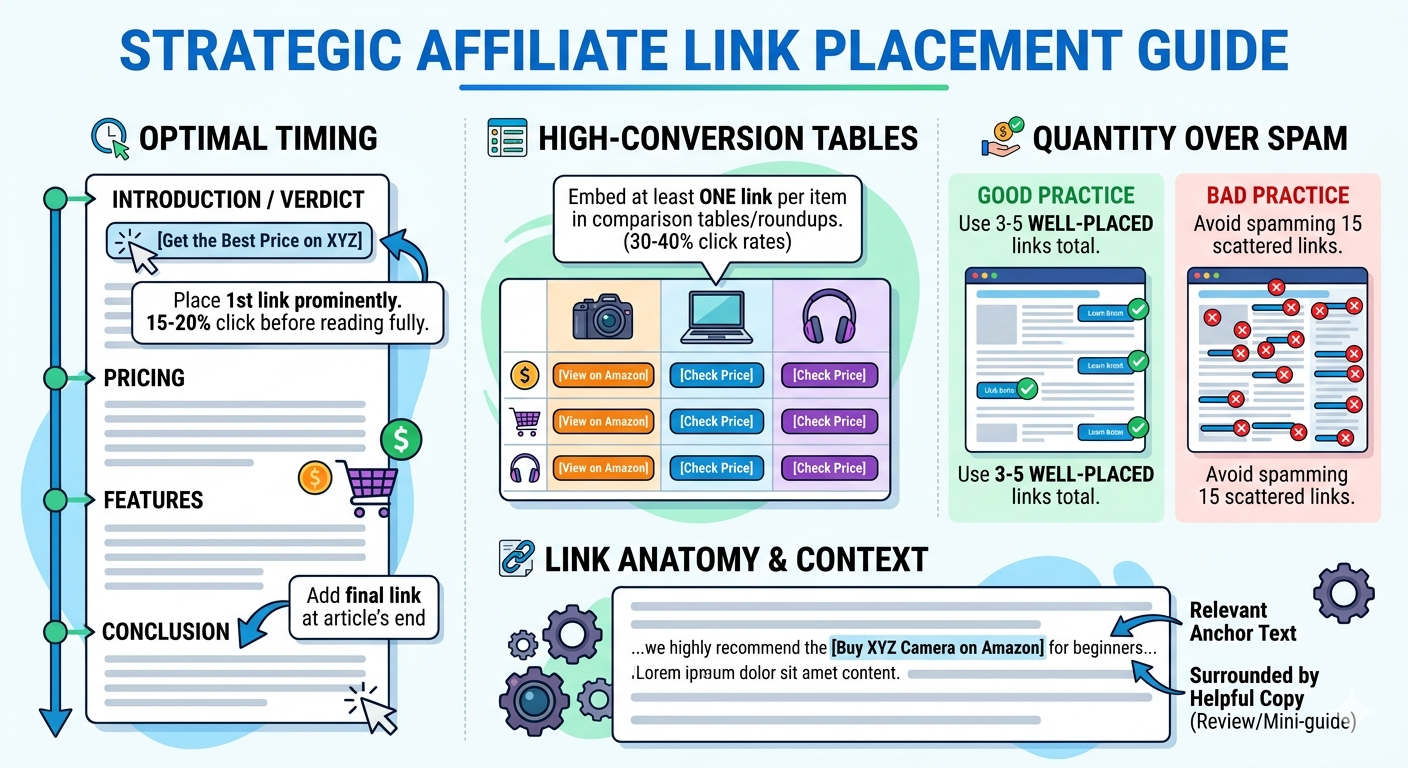
Where you place affiliate links matters as much as what you are promoting. Data shows 15 to 20% of readers click before finishing an article — so your first affiliate link should appear early, in the intro or opening verdict of a review.
The three highest-converting placement zones:
- First affiliate link in the intro or opening verdict
- Additional links after pricing information
- Final link at the article conclusion
Comparison tables and quick-pick roundups earn 30 to 40% click rates when each item includes a direct link. Aim for 3 to 5 well-placed links per page rather than scattering 15 across the content. More links do not mean more clicks — they mean diluted attention and a worse reader experience.
Why Anchor Text Quality Matters
Each link should use descriptive anchor text — "Buy XYZ camera on Amazon" rather than "click here." Descriptive anchors give readers context before clicking and help Google understand the relationship between your content and the linked product. Both outcomes directly improve click-through rates and organic visibility.
Mixing anchor text across links also matters for SEO. Using the exact same anchor phrase on every link signals unnatural optimization. Varying phrasing naturally — product name, benefit-focused text, action-oriented text — keeps links contextually relevant without triggering spam signals.
What Not to Do With Link Placement
- Burying the first link below the fold
- Using identical anchor text repeatedly
- Adding links without surrounding helpful context
- Cramming multiple links into a single paragraph
Content Types
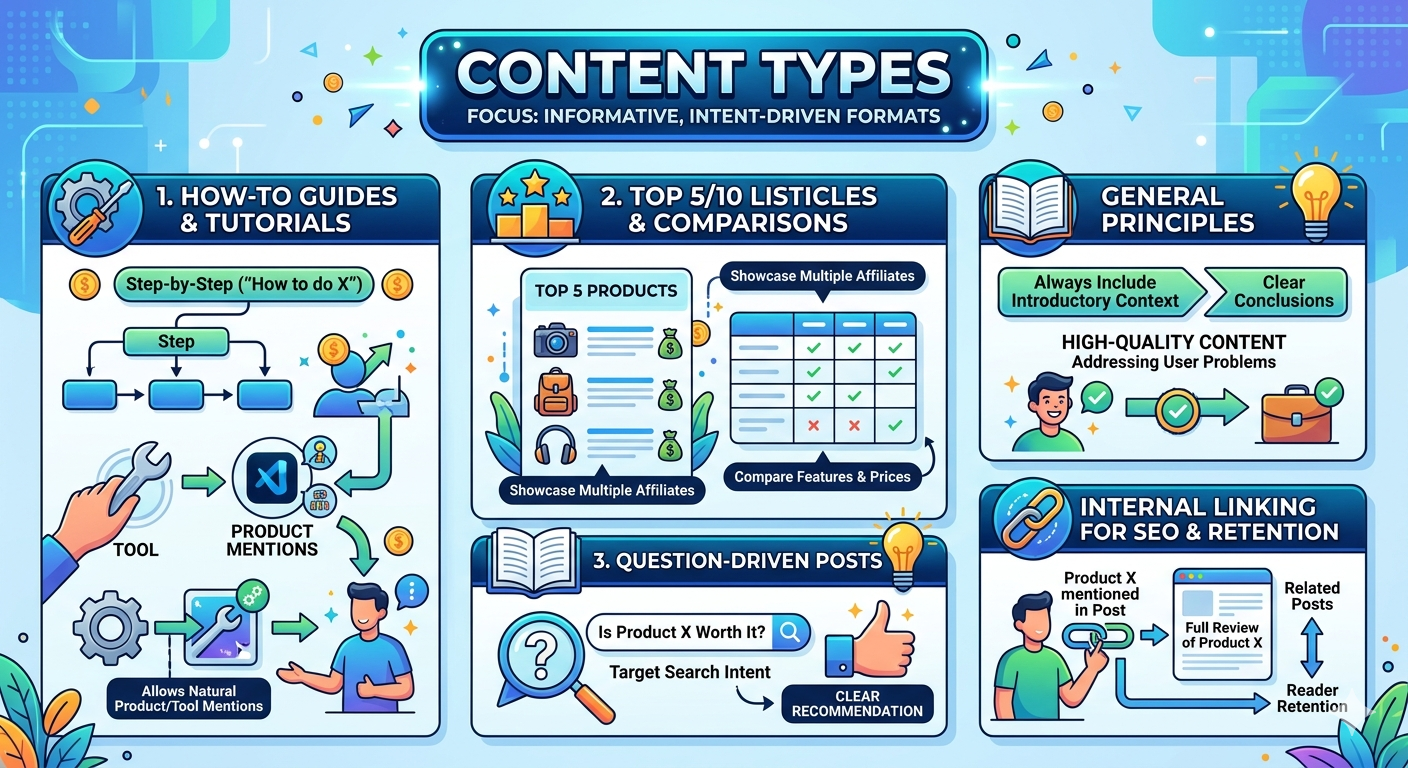
Not all content converts equally. The formats consistently driving the strongest affiliate revenue growth are built around buyer intent — reaching readers already in research or decision mode, not those still in early awareness.
The highest-performing formats:
- How-to guides and tutorials
- Top 5 or Top 10 listicles
- Comparison posts
- Question-driven posts
How-to guides naturally accommodate product and tool recommendations within step-by-step context. Listicles are ideal for showcasing multiple affiliate products in a single post. Comparison posts reach readers who have already narrowed their options and are close to purchasing. Question-driven posts — "Is Product X worth it?" — target specific search intent and end with a direct recommendation that moves readers toward action.
Always include introductory context that frames the problem, and a clear conclusion that gives a direct answer. Readers who feel their question was genuinely addressed are far more likely to click through than those who feel they received a list without guidance.
Internal Linking for SEO and Retention
Every post should link to related content within your site. A product mentioned in a listicle should link to a full review. A tutorial should reference a comparison post. A review should point to a roundup of alternatives.
This keeps readers on-site longer, reduces bounce rate, and distributes SEO authority across your content library — all compounding into stronger affiliate content strategy performance over time. Internal linking also helps Google understand the topical depth of your site, which contributes to ranking authority in your niche.
Offer Selection and Monetization Mix
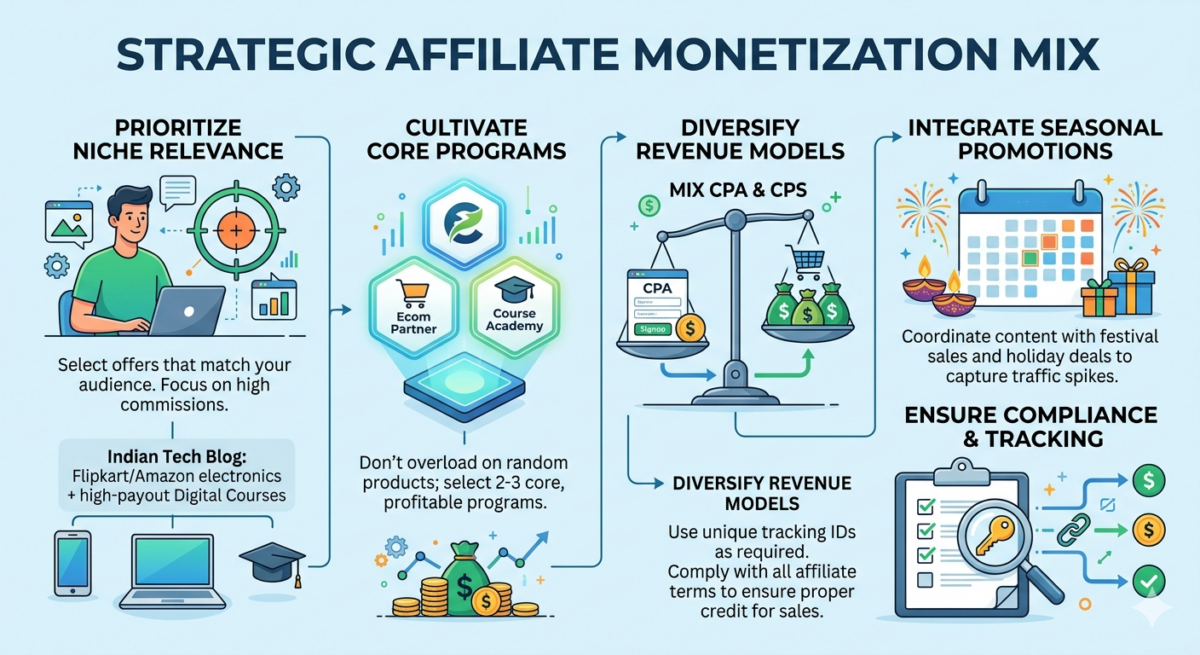
Promoting irrelevant products is one of the fastest ways to underperform in affiliate marketing. Commission rates matter, but audience fit matters more. A relevant lower-commission product will always convert better than an irrelevant high-commission one because readers buy what solves their problem — not what pays you the most.
Build depth around 2 to 3 core affiliate programs that genuinely align with your audience rather than spreading across dozens of unrelated products. An Indian tech blog, for example, performs strongest by focusing on Flipkart and Amazon electronics alongside digital courses with higher payouts — not by promoting every available program simultaneously.
Combining CPA and CPS for Revenue Stability
Affiliates combining CPA (lead generation) and CPS (sale) models create more stable monthly income. When direct sales slow, lead-generation offers stay consistent. When purchase intent peaks during Diwali, Black Friday, or Christmas, CPS campaigns capture that demand spike effectively.
Always use unique tracking IDs for each program and comply with affiliate terms to ensure every sale is credited correctly. Missing this step means losing commission on conversions you actually drove.
Building a Seasonal Content Calendar
Seasonal content should go live 6 to 8 weeks before the event — not after demand has already peaked. Brands running festival sales and holiday deals reward affiliates who prepare early. A gift guide published two weeks before Diwali captures far less traffic than one published six weeks prior and already ranking by the time shoppers start searching.
Compelling CTAs
Every affiliate mention needs a CTA that uses action language and gives readers a specific reason to click now. Generic CTAs consistently underperform tailored ones — "click here" moves far fewer readers than "Get 30% off before the sale ends."
Strong CTA examples:
- "Get 30% off — limited offer"
- "Try free for 30 days"
- "Enroll now — limited seats"
- "Grab this discount before it expires"
- "Download the free guide"
Tailor each CTA to the specific offer rather than recycling the same phrase across every product. A software trial CTA should feel different from a physical product discount CTA. Rotate phrasing through A/B tests to identify which angles resonate best with your specific audience.
Place CTA buttons or highlighted links near the product name, price summary, or key benefit statement — not buried in a paragraph of text where readers are unlikely to notice them.
Mobile Optimization Is Non-Negotiable
Roughly 62% of affiliate marketing traffic comes from smartphones, according to Cuelinks. A layout that works on desktop but requires pinching on mobile is actively losing conversions. Buttons must be thumb-friendly, load times under three seconds, and affiliate links clearly tappable without surrounding clutter competing for the tap.
A slow-loading page on mobile is not just a UX problem — it directly reduces rankings in Google's mobile-first index, meaning less traffic reaches your affiliate content in the first place.
Tracking and A/B Testing

Affiliates who do not track performance make optimization decisions based on guesswork. Google Analytics with goal tracking, combined with each program's native dashboard, gives a solid performance baseline. For more granular data, tools like Voluum or RedTrack track links across multiple campaigns — showing not just clicks but the full conversion path from first visit to completed sale.
Landing page split-testing tools like VWO, Optimizely, or Convert allow structured experiments on page-level elements — headline copy, button placement, image vs. no image, CTA phrasing — with clear data on what drives measurable improvement.
What to Test First
- Headline phrasing on product reviews
- CTA button copy and color
- Link position within the article body
- Image vs. no image in product blocks
Change one variable at a time. Measure before moving to the next test. Stacking multiple changes simultaneously makes it impossible to identify which variable drove the result.
Content Freshness Directly Affects Rankings
Outdated posts lose traffic steadily. Updating titles from "Best X of 2023" to 2026, refreshing data points, and replacing discontinued products keeps content ranking and converting. Ryan Robinson scaled from $17,000 to over $50,000 per month primarily by updating existing content and diversifying affiliate products — not by publishing more new posts.
Case Studies and Data Points

Real publisher results confirm what a structured affiliate marketing strategy produces at scale:
- Travel Mexico Solo — over $1 million in affiliate revenue in a single year through high-intent keyword targeting and detailed travel content
- Making Sense of Cents — approximately $50,000 per month using email list promotion, social proof, and transparent earnings disclosure
- Ryan Robinson — scaled from $17,000 to over $50,000 per month by refreshing old content and diversifying products
- Wirecutter — $70.5 million in Q1 2025 through unbiased product testing, thorough reviews, and clear affiliate disclosures
- The Points Guy — 10 million+ monthly visitors by continuously tracking and optimizing highest sign-up articles
Typical affiliates executing with clear strategy earn between $3,000 and $15,000 per month. About 83% of marketers now use affiliate programs. Retailers report affiliates contributing up to 20% of total revenue — confirming the channel's commercial weight when managed as a system rather than an afterthought.
Common Mistakes and Troubleshooting
Most underperforming affiliates share the same avoidable patterns:
- Spreading too thin — promoting every product dilutes focus and credibility
- No tracking setup — impossible to optimize without performance data
- Stagnant content — outdated posts lose rankings and conversions steadily
- Single traffic source — algorithm shifts can wipe revenue overnight
- Ignoring mobile UX — poor mobile experience kills conversions at scale
- Generic CTAs — readers need a specific reason to act now
- Ignoring early signals — low CTR usually means the headline or image is not resonating, not that the product is wrong
Conclusion
A results-driven affiliate marketing strategy combines intentional link placement, high-converting content formats, relevant offer selection, strong CTAs, and continuous data-driven optimization. Each element reinforces the others — better content attracts more traffic, better placement improves CTR, and better tracking shows exactly where to invest next.
Publishers who treat affiliate marketing as a system — not a passive income shortcut — are the ones consistently reaching five and six-figure monthly revenues. The data from Wirecutter, Making Sense of Cents, and The Points Guy all point to the same foundation: reader trust, content quality, and relentless optimization.
Joining a trusted affiliate network gives publishers access to vetted brand campaigns, consolidated performance tracking, and dedicated support — reducing operational complexity so more time goes toward content creation and revenue growth.